

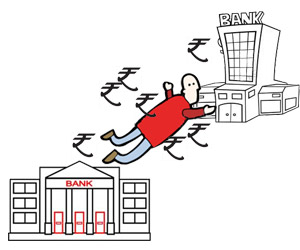
 The RBI has recently slashed key policy rates. This has encouraged some centralized banks to cut interest rates and many are expected to make a similar move soon enough. Pre payment charges on loans with floating interest rates have also been abolished. For now SBI has the lowest home loan rate at 10.15%. Under this circumstances anybody stuck with a cumbersome home loan and paying a high EMI that is draining a larger part of the income will be looking to switch banks.However even if you are switching banks or switching home loan schemes within the same bank, there are some things you should consider before taking such a step.
- There is no point in switching to a new bank if the new lender’s rate of interest is not at least 1 to 1.5% lower than the interest rate of your present bank. For example if you have a home loan of Rs 35 lakh for a 15 years tenure at a rate of interest of 11.15 % then your monthly EMI will be Rs 40,111. If the interest rate decreases by 0.15% then you EMI will be Rs 39,781, only saving Rs 330 per month. However if the rate of interest is slashed by 1% than you will have to pay EMI of Rs 37,933 which means you save Rs 2,178 per month which is far more substantial than the previous amount. And in 15 years you save up to Rs 3, 92,040.
- While switching banks or switching home loan schemes within the same bank, you will be charged a processing fee by the new lender that would vary between 0.5 to 1%. It depends on the outstanding amount of the loan. Processing fee imposed by SBI can be maximum be Rs 10,000. For switching within the same bank it will be between 0.5 to 2%. Though pre-payment penalty on floating loans have now been abolished some banks charge up to 2% pre-closure penalty. Some banks also add a charge for property verification and other exercises. So before jumping to switch banks for lower interest rate you have to calculate if you are actually saving any money at all after paying a penalty and a processing fee. Though it is advisable to switch banks in the initial years after taking the loan but the processing fee is higher during the initial years. Therefore it is hard to tell how profitable it is switch banks to get a lower interest rate.
- Switching during the initial years is profitable because in the initial years most of the EMI goes towards repaying the interest and a very small part goes towards repaying capital. So if you are switching banks to get a benefit on the interest it is best done in the initial years of your interest payment or when there are less than 5 years left of your tenure. But it has already been mentioned what losses you can incur by switching in the initial tears and a switch during the later part means most of your interest part of the loan has already been paid. So there will be no practical purpose for the switch. If you are stuck with a really high rate of interest such as 14 to 15% you can also opt for a switch. Otherwise it will really be of no real profit what so ever.