

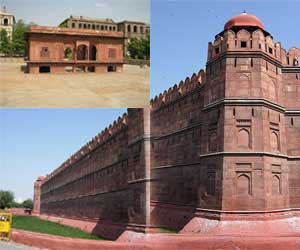
 Among the many historic monuments worth mentioning while Delhi touring the Red Fort is the most important monument. The Red Fort is the English name of the Lal Qila which is the common name on everybody’s tongue in the city. Lal Qila as the name suggests is a fort complex built in red sandstone in seventeenth century by famous Mughal Emperor Shah Jahan. It is located in the area of Delhi that was previously known as Old Delhi.This fort was used to be the palace residence of Emperor Shah Jahan who shifted his capital from Agra to Shahjahanabad which was the 7th city in Delhi. This place was the capital of Mughals until 1857 when the British Government exiled the last Mughal Emperor Bahadur Shah Zafar. The Lal Qila is situated at the bank of Yamuna River. In the year 1638 the construction of the fort started and it took almost ten years to complete it. In 1648 it was ready to use by Mughals. Even after its construction completed several new developments took place in the Fort. Some major additions were done by Shah Jahan while some other developments took place under Aurangzeb and later Mughal Emperors. Quite later world understood the importance of this grand heritage site and then in the year 2007 more than three and a half centuries later this monument is declared UNESCO World Heritage Site. At the north Eastern side of the fort there is another small fort situated.This fort is known as Salimgarh Fort constructed almost a century back by Islam Shah Suri in the year 1546 in order to use it as a defence place. The two architects who contributed to the construction and design of the fort were Ustad Ahmed and Ustad Hamid but the supervision is done personally by Emperor Shah Jahan. You can see the creativity and excellence of Mughals in the field of building grand monuments. The successor of Shah Jahan added Moti Masjid (mosque) at the private chambers of Emperor and Barbicans in front of main gates resulting in twisty entrance to the palace.Following is the order of various rulers who occupied this grand fort of India:Shah Jahan->Aurangzeb->Jahandar Shah->Farukhsiyar->Muhammad Shah->Nadir Shah (Persian Emperor)-> Muhammad Shah ->Marathas ->Ahmed Shah Durrani->Bitish->Bahadur Shah Zafar II (last Mughal to rule the fort)-> British Government ->Indian Army (1947) -> Archaeological Survey of India (22nd December 2003)The worst phase is seen by the Red Fort under the occupancy of British Government who stripped the grand fort of its valuables and sold them outside country. Not only this they also demolished several important structures inside and outside of the fort in order to prove their rule over our country. The Red Fort is spread over an area of 254.67 acres. It has about 2.4 kilometres of wall surrounding the fort. There are several towers and bastions at different places on the defence wall of fort. The height is different at different places. If you see the bird eye view of the fort you will find that the fort is almost in octagon shape. From the use of marble stone, high level of art work, intricate carvings at places, floral designs rich in colours and double domes reflect the fine Mughal architecture.The remaining structure of Red Fort has the following significant parts:Diwan-i-AamAs the name suggests it was a hall of public audiences in which the Emperor would sit in a canopied alcove to hear complaints or problems of people. This hall has several golden columns and very well decorated. Stucco work can be seen in the hall.Diwan-i-KhasIt was a hall used for private audiences and the private meetings held by Emperor. There is a rectangular chamber decorated with floral designs and golden piers rich in colour. In this chamber only the famous Peacock Throne was kept on a marble base. But Nadir Shah stole this precious jewel of Mughals in 1739 while the two marble bases Captain Tytler took away in 1857. One of these two pedestals is kept in the New York Metropolitan Museum.Nahr -i- BehishtIt is a continuous water channel connecting various pavilions in the imperial private apartments. The meaning of the words Nahr-i-Behisht is Stream of Paradise.the water in this channel comes from Yamuna River. In the palace design the influence of Hindu architecture can be seen.Zenana quartersThere are Zenanas which means women’s quarters. The Mumtaz Mahal and Rang Mahal are such two Zananas with intricate carvings and beautiful decorations. You can see here fine marble pool watered by Nahr-i-Behisht.Apart from these there is a Naqqar Khana (drum house), Moti Masjid (mosque), Hayat Bakhsh Bagh (life Bestowing Garden), the Hammams (royal baths), Muthamman Burj (tower), etc.On every 15th August since we got independence Prime Minister of India hoists the National Flag at the Red Fort. A sound and light show based on Mughal history is held here. It is quite popular among the tourists. After entering from the Lahore gate you get to see the retail Mall that has various jewellery and crafts stores. You can also explore the museum of Blood Paintings.Entrance FeeRupees 10 per head is charged but kids up to the age of 15 are free.RUCHI MAHAJAN