

There are many caves around Pune that invites you to explore history of ancient India’s architectural brilliance. Most of these caves are Buddhist caves clearly depicting Buddhism. Ellora caves are one of such splendid caves that can easily make you spellbound. The Ellora caves are located quite near the city of Aurangabad in the state of Maharashtra. The distance between Ellora caves and Aurangabad is just 30 kilometres i.e. 19 miles. These magnificent rock cut structures are said to be created by Rashtrakuta reign on the Charanandri hills. The Ellora caves consist of total 34 caves depicting three religious faiths Buddhism, Hinduism and Jainism respectively among which 12 caves are Buddhist caves, 17 caves are Hindu caves while 5 caves represent Jainism. These caves are given numbers to understand easily as follows:
- Caves 1 to 12 – Buddhist caves
- Caves 13 to 29 – Hindu caves
- Caves 30 to 34 – Jain caves
All these caves are quite close to each other representing the religious harmony in that period. The Ellora caves are declared to be the World Heritage Site by UNESCO because of its historical as well as splendid architectural significance. All these caves are being built during fifth to seventh century. The caves have different sections, multi storied buildings, temples, prayer halls as per the religious faith given different names to these sections.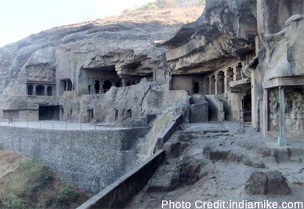 The Buddhist CavesIn Buddhist caves you find large rooms for living space, proper kitchens, sleeping rooms, temple, Chaitya hall, etc. The Vishwakarma Cave which is also called Carpenter’s cave is the most popular cave among all the other caves of Buddhist Section. The speciality of this cave is that it has a high ceiling carved beautifully like wooden carving impressions. It has fifteen feet tall statue of seated Gautama Buddha in preaching pose just in the centre of the hall like stupa. A huge Bodhi Tree carved on the rock is very impressive. The entrance of this cave is quite high like multi storied structure. The caves number one to nine are viharas that is the living place for monks also called monasteries while the cave number 11 and 12 are three storied buildings called Do Tal and Tin Tal respectively. The one to nine number caves also have some holy shrines inside them like stone carved Gautama Buddha, Bodhisattvas, saints, etc.
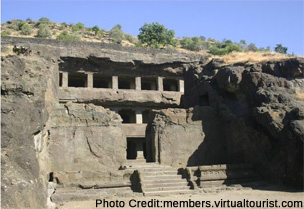 The Hindu CavesCave number 13 to 29 except 14, 15 and 16 were created during the Kalachuri Period while the caves 14, 15 and 16 were built in Rashtrakuta regime. It is supposed to be sixth century when all these Hindu caves were created. Whatever technology they used at that time the outcome was outstanding and beyond our thinking. No doubt that they must have a better planning and coordination skills that turned out to be such a huge and perfect monument in the Indian history.The cave number sixteen is the special attraction as it has a temple resembling the holy abode of Lord Shiva on Kailas Parbat. This cave has various superb wall carvings representing dancing Shiva (Natraj Mudra), wedding scene of Shiva – Parvati, another interesting wall carving shows that Ravan is lifting mount Kailas with his full strength while Shiva and Parvati are sitting on it with guards. Three main structures you can explore here are sacred bull Nandi, the Nandi Mandap and the Shiva temple. The temple was covered with white plaster in order to make it more look like mount Kailas. The Dravidian art is reflected in the design of this temple.The multi storied cave with huge intricate carvings represents the architectural skills those people had when no technology or machineries were used to lift the heavy weights of rocks. It is estimated that for creating these magnificent caves approximately more than 200000 tonnes of rock needed to be removed from place. I do not have a clue how they did it. These caves took almost hundred years to get the desired shape. Another cave in Hindu section is known as Dashavtara which is cave number 15. It has shown the ten different Avtaras of Lord Vishnu. It also shows the killing of Hiranyakashyap by the man-lion form of Lord Vishnu through its art work on stone.
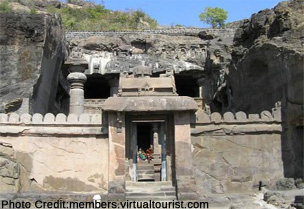 The Jain CavesThese are the last work in the Ellora caves. These five caves were said to be created in the ninth and tenth centuries. These caves were of Digamber jains that is one section of Jain followers. The caves have carvings on the walls, pillars and at the entrance of the caves depiction the Jain philosophy. There are various names given to the Jain caves like Chhota Kailas (cave 30), the Indra Sabha (cave 32), and the Jagannath Sabha (cave 33). Apart from these cave 34 seems unfinished having a hall with four pillars and a shrine. The carvings are quite impressive as well as detailed with attractive paintings on the ceiling of the caves. The Jain caves are a bit smaller in size as compared to the Buddhist and Hindu caves in Ellora.Visiting Hours:From sunrise till sunsetMondays closed for visiting.Ruchi Mahajanзайм на карту без отказов круглосуточновзять кредит онлайн