

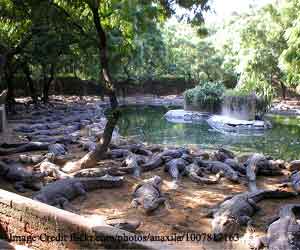
 When we hear the word bank what comes to our mind first. We think bank as a place where various financial transactions take place, where we deposit money or we draw money and such other functions. Have you ever wondered that there can be a bank of reptiles? Isn’t it quite unusual to listen but it is as true as you are. Yes, there is a bank of crocodiles. Before you assume that here you can purchase or deposit crocodile then let me correct you.It is of course a crocodile bank but is founded to conserve the endangered species of crocodiles. This crocodile bank is located in Vadanemmeli near Mahabalipuram and about 44 kilometres away from city of Chennai in the state of Tamil Nadu. This unique bank is established in the year 1976 by a German Biologist Romulus Whitaker. This bank houses Indian crocodiles, African crocodiles, salt water crocodiles, alligators and other reptiles like turtles, snakes and lizards. During the late nineteenth century crocodile hunting was on its high point due to the vast commercial use of crocodile skin.In the year 1972 government of India made wild life protection act that helped somehow in preventing the extinction of crocodile species. Then this non profit crocodile bank came into existence in 1976 with an aim to promote the conservation of reptiles and amphibians and their habitats through education, research and captive breeding. They teaches the ecological importance of Crocodiles in the life system as they feed on sick, weak and injured fishes of water thus helping the ecological system. It is spread over an area of 8.5 acres or 3.4 hectares of land amid lush greenery and coastal line.The area where the bank is situated is naturally green thus providing a natural habitat to the reptiles and dense tropical vegetation helps in providing enough shade to rest to these creatures. The success of the centre lies in its statistics because when the centre was founded only 30 crocodiles made the population but today there are fourteen different species of Crocodiles, twelve species of turtles and five species of snakes are there in the bank. These all together make 2400 reptiles in the centre.The bank mainly houses the following types of crocodiles:
- Indian crocodile or Mugger whose scientific name is Crocodylus Paluster with a length of 3.6 meters.
- Ghariyal or Gavialis Gangeticus – 4-5 meters long with a long jaw
- Saltwater Crocodile – Crocodylus Porosus which is the largest reptile
- Morlet’s crocodile from Mexico
- American crocodile from Africa
- Dwarf crocodile from Africa
- The Siamese crocodile
Among the above types of crocodile the first three types make a major population in the bank. If you are a reptile enthusiast then must visit this exclusive bank of country. there is a snake farm in the bank. In this farm anti venom is produced with an annual turnover of US$15000. There is a research centre in the bank where research on the biology of crocodiles, alligators and turtles is done. They also observe lizards. It is a delight to watch the reptiles in open pools here for reptile lovers. The Crocodile Bank is also planning to set up another such centre to preserve and breed endangered species of reptiles on the western coast on country in Goa in near future.Opening daysThe Crocodile bank is open from Tuesday to Sunday but closed on Mondays.TimingsThe timings are from 8.30 am to 5.30 pm every day.Entrance chargesRs. 35 for adults and Rs. 10 for kids below ten yearsContact number+91-9840542337Website: www.madrascrocodilebank.orgRUCHI MAHAJANзайм на карту без отказов круглосуточновзять кредит онлайн