

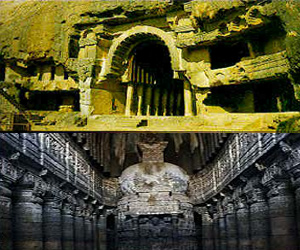
 Maharashtra state has rich geographical topography that makes the state much interesting. It has hills, mountains, rivers, plans, valleys, etc. almost all forms of land and that might be the reason why this place was chosen for cave excavation in ancient period. The state has numerous Caves in its mountain treasure. Some of them are extremely intact even after two thousand years while others are just the structure. Caves always fascinated me as they give you an idea how people in that period have created such vast caves that too without the help of modern technology. Even today we can’t imagine creating such wonderful places without using single machinery. Today I am taking you to the spectacular Junnar Caves which are not very far from Pune city. Most of the caves in Maharashtra state represent Buddhist, Hindu and Jain religion but Junnar caves are more of Buddhist caves and are a quite significant Buddhist pilgrimage destination. Junnar caves are located in Aurangabad District of Maharashtra state. You can imagine the popularity of these caves by the fact that tourists from around the globe come here to explore these caves. Among these tourists most of them are followers of Buddhism. There is not a single cave but many in this area. The deeper you go, the more you find. All these caves are quite important from archaeology’s point of view because they were all created between 2nd BC and 3rd Century AD.The Junnar caves are divided into three different groups. Among which Tulija Lena, Ganesh Lena are quite famous. Most of the caves are actually hidden and can’t found or seen from the ground or a distance. But when you go closer the treasure box opens up one by one and you get to explore the most magnificent structures inside these caves with proper ventilation and natural lighting system. The area from all around is covered with lush greenery and it might be possible that centuries back this area must be under thick woods and thus became a suitable place for meditation and living. Today also the place looks so appealing because of its unique location amidst the green cover that tourists feel amazing.As in all Buddhist caves depict special architecture these caves also have the same features. There is a chaitya hall with circular dome ceiling that makes it very eye catching as the ceiling is very high. The hall is quite spacious and a bit different from other Buddhist caves of country. This Chaitya hall comes in the Tulija Lena group of caves. Close by Manmodi Hills houses the second group of caves. These caves are also preserved best as Archaeology department do research and study the sculptures and images here.The third group of caves are known as Ganesh Lena caves. The caves under this group are very attractive and crowd puller. In these caves you can explore the special Vihara which is called Ganesh Lena, several small chambers that might be used to live and Chitya halls. For easy identification the caves are numbered like cave 1, cave 2, etc. Among these caves the cave numbers six and fourteen are considered very special as they have Chityagrahas as well as viharas. Cave number seven has a shrine of Lord Ganesha which is one of the Ashtavinayak temples and religiously very significant for Hindu population. Girijatmaka is the name of this temple and to reach here one needs to climb 238 stairs. The total number of caves is about thirty. All of them are rock cut Buddhist caves situated close to the North West banks of Kukadi River. It is quite fortunate that these caves are not neglected as it happens with most of the historic monuments in India. These are properly maintained and preserved by the Archaeological Department of India.Distance of Junnar CavesFrom Pune – 94 kilometresFrom Mumbai – 177 kilometresRUCHI MAHAJAN займ на карту без отказов круглосуточновзять кредит онлайн