

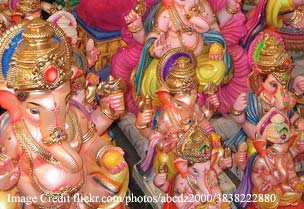
 Ganesh festival, also known as Ganesh Chaturthi, is celebrated in India with great zeal. Lokmanya Tilak started this festival during the freedom movement. This festival begins with Shukla Chaturthi and ends on Ananta Chaturdashi as per the Hindu calendar. Ganeshotsav usually falls in the month of August or September. This festival is particularly celebrated with enormous enthusiasm in Maharashtra. The state boasts of its historical and immortal pandals. People from across the globe specially fly down to Pune and Mumbai to be a part of these celebrations. Let us find out more about the festive celebrations in Mumbai…One of the most famous and respected Ganpati temples, Siddhivinayak Temple is located in Mumbai. Apart from this temple, some of the other most popular Ganesh Mandals in Mumbai are:
- Sahyadri Krida Mandal, Tilak Nagar.
- Nikadvari Lane Sarvajanik Ganeshotsav Mandal, Girgaon.
- Lalbaugcha Raja Sarvajanik Ganeshotsav Mandal.
- Lalbaug Sarvajanik Utsav Mandal, Ganeshgalli.
- Sarvajanik Shree Ganeshotsav Mandal, Khetwadi.
- G.S.B. Seva Mandal, King Circle.
- Akhil Mugbhet Ganesh Mandal, Girgaon.
- Gaondevi and J.K. Bldg Sarvajanik Ganesh Mandal, Girgaon.
- Keshavji Naik Chawl Ganesh Mandal, Girgaon.
- Khattar Galli, Girgaon.
A number of other big and small mandals erect canopies, domes, etc. Each of this has an idol of Lord Ganesh, which is worshipped twice every day. These pandals exhibit a number of legendary anecdotes. Some of the small pandals conduct orchestras and other such folk and cultural programmes. Every evening during this festival, huge masses are gathered across these pandals. Many temples conduct various programmes, the most common being the infinite chanting of ‘Atharvashirsha’.During the ten days of Ganeshotsav, the evening ‘aarti’ attracts a number of devotees. The common Prasad served is pedhas, laddoos and modak, which is believed to be the Lord’s favourite delicacy. These are the typical celebrations that are carried on during the ten days of the festival. The biggest attraction of the Ganeshotsav is the immersion procession. The streets of Mumbai are jam packed with crowds. A long parade of the mandals covers up these streets. Each of the mandal has a ‘dhol pathak’, which is nothing but a troupe of musicians and dancers. The musicians play loud ‘dhols’ (big double-sided barrel drums) and ‘tashas’ (small drums and sticks). The music created by these instruments is said to provoke the innermost spiritual energy of the staunch devotees of the Lord. The most typical dance form during these processions is the ‘lezim’. The instrument used by these dancers is ‘lezim’, which is why this folk dance form is called so. The female dancers dress up in nine yard saris and the male dancers wear kurta-pajama with a turban. Every pathak has a saffron flag, which symbolizes the Hindu religion. The immersion processions go on for two days in Mumbai. The idols are immersed in the Arabian Sea.However, every year, Mumbai faces a number of environmental problems due to these immersion processions. Let us all pledge to celebrate the festival this year in an eco-friendly way.займ на карту без отказов круглосуточновзять кредит онлайн