

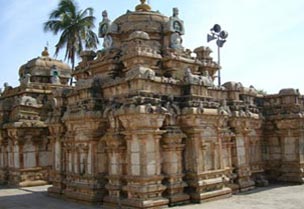
 While religious heritage exploration in Bangaluru I came to know about an eighth century temple situated just twenty five kilometers from the City in small less popular village known as Begur. This small hamlet off Bangaluru – Hasur Highway was once a significant centre for Sanskrit and Vedic studies. But now the negative effects of time have taken away the glory of this place leaving behind a thirteen hundred years old Shri Pancha Lingaeshawara Temple which has managed to survive somehow. This historic temple also known as Begur temple was built in the eighth century by two rulers, Shri Kulutunga Raja First from Chola Dynasty and Shri Rajasimhanandi of Talakad Ganga Dynasty. Actually the history says that there are total hundred and eight temples (108) created by them across South India and this temple is the 18th of those 108 temples. The structure of the temple is simple but beautiful and spiritual. Granite stone is used to create this temple.Apart from the temple there is a historic tank and a fortress almost in ruins made of mud to attract your attention. This fortress houses the temple of Kashi Vishweshwara. There is a distance of just 1to 2 kilometers between the two temples. The Pnach Lingaeshwara temple has the idol of Lord Shiva as the main deity apart from five Lingas that makes this shrine very special. The oldest among them is the Nageshwara who is one of the forms of Lord Shiva. On the occasion of Shivaratri and Kartika Somvara devotees perform various Poojas and offer prayers. On Shivaratri people keep awake the entire night in order to devote their prayers to the almighty. Another big festival that is celebrated with full zeal and zest here is known as Bramha Rathotsav (Chariot festival). This festival falls in the month of April and attended by many people from local as well as surrounding areas. This place is still not developed as a tourist destination that is why it has less number of tourists but lots of devotees.The dome of the temple has resemblance to the Dravidian style of designing. The height of the roof is so low that a tall person has to bow down a little to roam inside the temple. The carvings on the pillars are not representing any one style but a mixture of different patterns thus giving a sign to us that the temple may be constructed or renovated by different people in different time lines. The most interesting thing about this temple is that it houses many inscriptions clarifying the historical facts since the time of its inception. In one such inscription some proofs of Bangaluru are also found. It proves that Bangaluru is also a nineteenth century city. There are many other facts also came to light by these inscriptions. Some old stones of that time also here to tell the historical events but it is quite unfortunate that they are just kept aside near the compound wall neglected totally like ordinary stones without any preservation. Some of these stones are now broken into two pieces struggling to survive to tell the history but in vain. It is a real shame for us that we cannot preserve the oldest inscriptions found on stone saying the history of Bangaluru.There are many signs that give us proof of having Jain history in Begur as there many bits and pieces are found of Jain settlements here. Nagattara who was the chief of Gangas was himself a Jain and inscriptions has it that his daughter Tondabbe had given her life in Santhara (Sallekhana) which is a Jain Ritual in which a person fasts till death. The fort made of mud has an entrance that is not visible directly. It may be done so to protect it from enemies. Here also you find proof of Jainism as on the stone entrance gate there is a figure being carved performing Sallekhana, the Jain Ritual. This picture might be of the daughter of Nagattara. There is not much left to explore inside the fort. The old well which still has clean water can be seen. It is said that there was a Jain teerth known as Chokkinalaya Jinalaya here but now nothing is left except some signs of ruined history like a headless statue of Jain Teerthankara in the state of meditation along with some carved stones. Visiting this place can be a nice experience for everyone. Easy connectivity from the NH 7 makes this place reachable as the highway is just 2.5 kilometers away and I must mention the roads are good. The nearby Begur Lake does make the place worth spending time and exploring. BTMC buses as well as auto rickshaws are the local transport available here.Ruchi Mahajan