

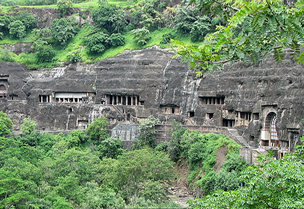
 The state of Maharashtra has very rich historical treasure that is worth exploring. One such historical place is Ajanta Caves in the district of Aurangabad in Maharashtra state. These caves are one of the most fascinating historical monuments not only in the country but in the world. Ajanta caves are situated near the village of Ajintha. There are total 29 caves made from cutting the rocks found here. It is said that these caves were built in two different periods. The older caves were built somewhere around 200 BCE while the second part was supposed to be built around 600 CE. The caves give clear cut impression of Buddhist religion as you find here viharas, Buddha statues, huge prayer halls, wall paintings of Vajrapani and Padmapani, temples, etc. The art work in these caves is astonishingly beautiful. It is believed that the Satvahna Dynasty that ruled from 230 BCE to 220 CE must have helped in creating the master piece of the first phase of Ajanta Caves. The first phase of caves is called Hinayana Buddhist Sancturies or Chaytia Grihas. The interesting fact here is that the second phase came into existence much later to the first phase but no one actually determine the exact period of construction.As one version says that the second phase was built in a long duration from fourth to eighth century while the other version says that the next phase was built in a real short period of twenty years from 460 CE to 480 CE. The difference in the opinions is surprising but the significant thing is that these caves are actually the masterpieces of art work in the Indian history. It is said that in a short span of time almost twenty caves were built by excellent artists of that time. These caves also include Viharas, temples and Sanctuary in the centre. The second period caves were created during the time of emperor Harishena but after his dynasty ended in 480 CE the things changed and the caves were left abandoned since then to be lonely. No one ever lived there after that and during the course of time that turned out to be centuries left the place unnoticed, unexplored and hidden. Dense forest grew all over the place to make it invisible and untouched.After more than twelve long centuries the splendid Ajanta Caves were rediscovered accidently by a British Officer named John Smith from the Madras Presidency on 28th April 1819 when he was on Tiger hunting spree. The first cave he came to find was the cave number 10. He scratched his name and date on one of the pillars of the cave. After this discovery the Ajanta caves become world famous for their extraordinary architecture and splendid artwork. The cave number two is having beautiful preserved paintings on walls, ceilings as well as on pillars of that time. The elaborate carvings, well planned and strong architecture, impressive entrance doors, magnificent artworks and intelligent interiors of the Ajanta caves make it most spectacular example of ancient technology in building construction that without any help of machinery. It is amazing. Even though we live in the modern time where technology is superb and advanced machineries are available to complete any task but still we cannot built a structure that can remain as it is after hundreds of centuries with all its interior decoration. The wall paintings have the Jataka tales that are educational for the readers as it is said that in these tales the teachings of Lord Buddha in his different births are explained. It needs special attention to get them right as with time some wall paintings have faded. The cave number 4 is the largest among all but this monastery which has many individual cells, prayer halls, veranda, temple and statue of Lord Buddha seem to be incomplete. It is very well planned structure on a grand scale but never finished. The image of Buddha has some details on it that said that a person called Mathura had gifted this it. It is supposed to be the 6th century. You can find the details that are given outside the cave by the Archaeological department of India. The best part of this art work is that this kind of art work, paintings and the method used to create these spectacular works is unique as no other civilization has shown such an interesting and beautiful work before in the history.The Ajanta Caves are declared World Heritage Site by UNESCO in the year 1983 for its impressive architecture and unique ancient art work of art. The distance of Ajanta Caves from various nearby places is as follows:Aurangabad – 104 kilometresJalgaon -59 kilometresEllora Caves – 100 kilometresThe Ajanta Caves are closed on Mondays.It is must visit place with your family to explore the rich heritage of ancient time. A humble request is that please help to preserve this treasure and try not to harm any part of it intentionally or by mistake after all these historical monuments help us to educate our younger generation about the intelligence and skills that our ancestors had in that time period.Ruchi Mahajanзайм на карту без отказов круглосуточновзять кредит онлайн