

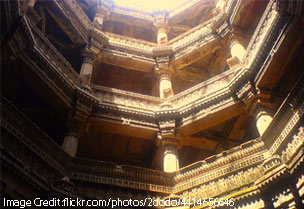
 There are many magnificent examples of ancient architecture in the state of Gujarat and if you want something different from holy shrine or forts then come with me as I am taking you to the journey of a place that is absolutely fantastic and far sure it is neither a temple nor a palace but a step well. Yes, you read me right. Just 18 kilometers from the city of Ahmedabad under the Gandhinagar district in the tranquil village of Adalaj situated a fabulous master piece of amalgamation of Hindu and Islamic architecture. This well is known as Adalaj Step Well or in Gujarati language it is called Adalaj Ni Vav (Bavdi, Bavri). It is basically a Hindu water building. The construction work of this well started in the year 1498 while it completed in 1499. The structure mainly includes a five storied deep well surrounded by octagonal five levels.If we go into depth of the history of this well then we find an interesting tale which might be true. King Rana Veer Singh from Vaghela Dynasty initiated the construction work of Adalaj Step well that came into Dandai Desh at that time. But when he died in a battle with Muslim ruler Mohammed Begda his territory was taken over by the Muslim ruler. King Veer Singh’s very beautiful wife Rani Roopba who was in deep grief agreed to a marriage proposal by Muslim ruler Begda and in return he had to complete the construction work of the step well. Deeply moved by the beauty of the queen he created the best step well for her. The Muslim ruler reminded the queen of the proposal but the queen had something else in mind. She like a proud Hindu Wife offered prayers to God in the newly built step well and then ended her life by jumping into the well to mark her devotion for her husband. Thus the inauguration was a tragic story for this popular step well. This is not the end of the tragedy related to this step well. The architectural excellence of the structure influenced the Muslim king Begda so much that he never wanted anyone to build a replica of Adalaj step well so called the all six builders who made this beautiful well and asked them if they can build another one just like this. Without having any idea of the consequence when they answered in a yes, all of them had to lose their lives in the hands of Mohammed Begda. You can see the tombs of these six people near the Adalaj Step well or Vav. It is really disappointing to hear such tragic tales of history.The step well is intricately carved on stone and it gives clear reflection of a mixture of Islamic and Hindu architecture as the very common in Islamic architecture flowery carvings on stone is seen here. These step wells are quite common in the west region of India. Only in the state of Gujarat you will find more than 120 such wells which were used as a resting place for people travelling long distances on their trade routes and caravans. The specialty of this step well is that it has three side entrances that all open up in the first story of the building. The temperature inside the building is almost six degrees low than the outside temperature as the direct sunlight is a rare event in the well building due to its depth. The centre opening gives the light and air inside the well. This five centuries old structure is still standing tall and deep in spite of weather harshness. The structure has large number of pillars to support each level. These wells or stepped ponds were also used for colorful festivals as well as for performing some sacred rituals apart from fulfilling drinking water needs bathing and washing purposes. These kinds of rock cut step wells were built in India first during 200 AD to 400 AD. The events happened during the construction of this well are carved on the walls of the well as it was started by Hindu but decorated by a Muslim.The walls are carved to display various activities performed by a village woman like buttering milk, adorning herself, musicians and artists performing while King is watching the activities sitting on a seat, etc. apart from these the sacred carvings on a rock stone of Ami Kumbor which means a symbol of pot of water of life and Kalp Vraksh which is a tree of life are also there. The nine planets (Nav Grah) are also depicted on the walls of step well. The walls do have flowers and Islamic graphics with a blend of Hindu as well as Jain Gods beautifully carved on various levels of the step well building. Villagers come here to perform sacred rituals here. Village women come here not only to fetch water but to offer prayers and not to forget spend time in gossiping in the cool interiors of the well.The best time to visit this place is from October to March. One should avoid hot summer months and try to reach inside when sun is on top to experience the cool climate inside and the reflection of light that makes the interiors of the well most admirable. The Adalaj Step Well is open on all days.Ruchi Mahajanзайм на карту без отказов круглосуточновзять кредит онлайн