

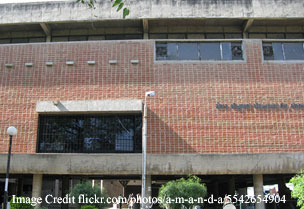
 While exploring museums of Ahmedabad if you have not visited the Lalbhai Dalpatbhai Museum then your exploration is not complete. It is one of the finest museums of Art and Archaeology in Ahmedabad city. It takes you to a journey dating back to hundreds of years by its rich historic collection of art, manuscripts and much more. The Lalbhai Dalpatbhai Museum was established in the year 1984. It is situated at the western part of city in Navrangpura in Ahmedabad. Located at a very spacious campus the area is surrounded by various educational & research institutions. Actually this museum born out of an institute started in the year 1956. This institute used to collect and preserve rare manuscripts and arts. When the collection reached its height the necessity to establish a museum was felt in order to display the rich collection from the history. Thus the museum got its shape. The credit to start this museum goes to two significant personalities, Muni Shri Punjyavijayji, a learned monk scholar and Shri Kasturbhai Lalbhai, famous industrialist of Ahmedabad. The new building for museum is designed by Architect Shri Balkrishnabhai Doshi and it was opened for public view since 1984.This museum has represents diverse branches of Indian philosophy like Buddhism, Jainism and its shastras, darshans, Vedas, agamas, etc. With around 75000 Jain scripts along with 500 illustrations and 45000 printed books this museum has become the largest museum in the country to exhibit such a vast collection. The books exhibited here are in various languages like Sanskrit, Pali, Old Gujarati, Hindi, Apabhramsa, Rajasthani, etc. The main attractions in the museum are the palm leaf manuscripts, third century sculptures and pre Mughal Miniature paintings. The museum has different sections named after the person who either donated the collection or helped in making the collection.These sections are called galleries. There is one Madhuri D. Desai Gallery named after Madhuri Desai who donated several sculptures to the museum. The collections in this section are as follows:
- A masterpiece with the largest head of Lord Buddha in stucco from Gandhara (3rd – 4th century)
- The earliest cult image of Lord Rama, Gupta period from Devagadh, MP (6th century)
- Rare figure of Mother Goddess Aindri from Shamlaji, Gujarat (6th century)
- Bronze idol of Adinath (Jain Tirthankar) from Sirpur, Maharashtra (7th – 8th century)
- Jain bronze idol from Ghogha from Bhavnagar, Gujarat
- Some magnificent idols of Buddha from Mathura, Sarnath, Nalanda, Nepal & Tibet
- Chola sculptures from Tamil Nadu (10th – 12th century)
- New addition to this gallery:
Nine portrait statues of significant persons from Gujarat (medieval period) comprise Solanki King, Maharaj Jaisingh (Siddhraj) (13th century)Another major exhibit gallery is Muni Punyavijayaji Gallery which displays the following collection:
- Gujarati Jain style paintings (before and after Mughal period)
- Rare illustrated wooden book covers known as patli shaped for palm leaf manuscripts
- Jain pilgrimage painting on cloth from Champaner, Gujarat (1433 AD)
- Vijnaptipatra document from Agra painted by Mughal painter Ustad Salivahana (1610 AD) It was a letter referred to Mughal king Jahangir’s Farman in order to stop the animal killings during Parushana (a Jain festival).
- The Kalakacharyakatha in Mandu style (1430)
- The Matar Sangrahani sutra by Chitara Govinda (1583)
- The Shripala Rasa in Rajasthani style (18th century)
- Adhidvipa the cosmological diagrams (1440)
- The grand Jain Siddhachakra yantra
The third section is called P.T. Munshaw Gallery which displays the collection of coins of India which includes:
- Earliest punched marked coin bentbar (600 BC)
- Akbar’s Din – e – Ilahi coin
- Jahangir’s Zodiac series in silver metal
- Adil Shah’s Larin (1668)
The fourth section is Shri Arvindbhai Gallery that displays:
- Natraja in Chola style
- Nepali/Tibetan Bronze Mandala (11th century)
- Decorative Chinese/Japanese style wooden cupboard (18th century)
There is another gallery in the museum named Shri Kasturrbhai Lalbhai collection which exhibits vast collection of Indian drawings from Calcutta. There is an L.D. Museum Conservation laboratory working towards preserving miniature paintings, preliminary surface cleaning of stone sculptures as well as metal objects.Museum timingsMuseum is closed on Mondays and public holidays.Opening timings in summer (1st May to 15th June) – 8.00 am to 1.00 pmOpening timings rest of the year – 10.30 am to 5.30 pmEasy accessibilityRailway station 7 kilometresAirport 12 kilometresRuchi Mahajan