

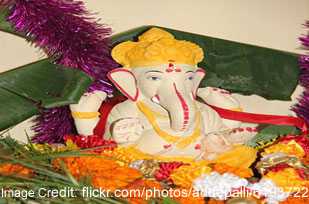
 Ganesh Festival, popularly known as ‘Ganesh Chaturthi’ and ‘Ganeshotsav’, is celebrated for ten or twelve days every year mostly in the month of September. Lokmanya Tilak started Ganesh Festival in the year 1893 with a purpose to bring together the masses of India to fight against the Britishers. One of the other reasons behind this was also to bring together the Brahmins and the non-Brahmins, who had a number of unsettled and unwanted issues amongst themselves.The tradition of celebrating this festival together has been continued ever since then. A number of pandals are put up all over the streets by the devotees. These pandals are nothing but an artificial and creative set ups of epical stories, other festivals and so on.Usually, the Ganesh idols are made out of Plaster of Paris. However, as of late, with the great fuss that is made about the global warming, awareness has been created about celebrating this festival in an eco-friendly way. Let us find out more about the eco-friendly celebrations of Ganesh Festival.An eco-friendly Ganesh idol is made out of natural clay. The ingredients of this clay include natural raisin, paper pulp and multani mitti. The colours used for painting these idols are created out of turmeric, flowers, vegetable dyes and other natural non toxic colours.How to make an eco friendly Ganesh Idol?
- The paper pulp is made out of the books where devotees write down the holy prayers and chants. Regular newspapers can also be used.
- These papers are then soaked and the water content is removed.
- The pulp is spread out properly in order to attain uniformity.
- 250 gm of Gum Arabic and 1.25 liters of water is mixed together in a steel container and is boiled for about 15 minutes.
- This mixture is stirred throughout with the help of a wooden stick, and then the Gum Arabic is filtered once the mixture is cooled down.
- 500 gm of paper pulp is mixed in the Gum Arabic, and then 2.25 kg of white ink powder is added to this mixture.
- This mixture has to be mixed properly until it becomes like dough.
- The Ganesh mould should be cleaned with water, and then dried. It could either be of fiber or rubber mould. Mixture of oil and soap, and natural shell dust should be applied from within respectively for these moulds.
- The paper Mache should be rolled out a 1 foot radius, like a chapatti. The rolled paper Mache should be lined inside the mould, and pressed properly so as to create and shape the impressions.
- This mould should be dried out in sunlight for two days. Slowly, the mould should be opened either from the middle or the face portion. Polish paper should be used for polishing these impressions.
- Finally, paint the impressions with herbal/natural colours.
- Remember to handle these idols carefully and tenderly.
The concept of eco friendly Ganesha has gained immense popularity in the Metropolitan cities like Pune and Mumbai. Today this festival is celebrated without causing harm to the environment.Benefits of using an eco-friendly Ganesh idol:
- Paper pulp Ganesh idols dissolve in water within a few quick hours.
- Paper pulp idols can easily be immersed in a bucket at your home. This way water pollution in the seas and rivers will be avoided.
- Since the use of natural colours is made, the pollution caused due to harmful chemicals is also avoided.
- Eco-friendly idols are light in weight. So it is easy to carry them.
- Traditionally, the idol is supposed to be made out of natural clay. Going the eco-friendly way will help you to keep up with your traditions.
A number of NGOs and other volunteers are working towards creating awareness of the ‘Green Ganesh Festival’. Let us all participate in this initiative and work towards protecting our environment.займ на карту без отказов круглосуточновзять кредит онлайн