

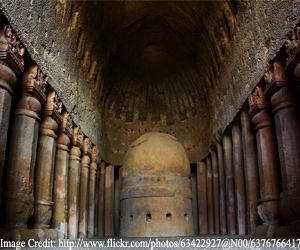
 Among the many magnificent caves hidden in Maharashtra state the Kanheri Caves is one of them. These are actually rock cut group of Buddhist Caves situated at the North side of Borivali inside the dense forests of Sanjay Gandhi National Park in the western outskirts of Mumbai. The distance of the caves from the main gate of National Park is about six kilometers. There are total 109 caves here. These caves are said to be built from 2nd century BC to 10th century CE. These rock cut caves were created during the Maurya and Kushana dynasty. There are various sections in the caves including Viharas, Chaityas, prayer halls, etc. Buddhism was quite influencing religion at that time and thus we find Buddhist caves at several places in the country. These caves were actually used to study, meditation, pray and live by the followers of Buddhism. The special section Viharas actually used for all these activities by the Buddhist monks. These places were later on converted into monasteries by the end of third century. There are various inscriptions found in the caves depicting the life events as well as the preaching of Lord Buddha.The word Kanheri is derived from Sanskrit word Krishnagiri which literary means Black coloured mountain. The Kanheri caves are carved from cutting one giant Basalt rock which is black in color and that is why these one hundred and nine caves are called Kanheri Caves. A clear influence of Buddhism on the art and culture can be seen by these caves in the country at that time. The Kanheri caves are situated at a height of 1500 feet above the sea.The rock cut steps are clearly seen in hundreds of numbers to reach the caves here. The sleeping beds in each cave are not very fancy and unadorned but were made of Spartan (stone) plinth still intact at the caves. A very well groomed Vihara with pillared corridor, main entrance reached through the flight of few steps is quite impressive. The intricate carving is still recognizable. The worship hall is adorned with huge pillars, a stupa and a Buddhist Shrine. Every pillar is same as the other one with beautiful carving work. Sometimes I wonder how long it might have taken to create this stone magnificence in a time when no machine was there to help. You might be wondering how would monks arranged the water at such a height then let me tell you that everything was planned very well as you go farther upward you can notice canals and Cisterns which used to be a part of water management system of ancient period. These canals were connected to a huge water reservoir where rain water was stored. After the conversion of these caves into monasteries the interiors of the caves further carved with the reliefs of Buddha and the Bodhisattvas. No one can deny the fact that this place had become a significant Buddhist settlement area at the Konkan coast by the end of third century. Here at the caves you can explore:
- Buddhist Viharas
- Chaityas
- Buddhist sculptures
- Reliefs and pillars
- Rock cut stupas
- The impressive image of Avalokiteshwara
- Stone inscriptions in Brahmi, Devanagari
- 51 readable inscriptions
- 26 epigraphs including 3 Pahlavi epigraphs discovered in cave 90
- Unfinished paintings of Buddha on the ceiling of cave 34
How to reach?It is quite easy to reach Kanheri Caves as state bus transport is available every hour.Entrance chargesThere is an entrance fee that needs to be paid at the entry gate of park and at the entrance of the caves.TimingsFrom 7.30 am to 5.30 pmAddressThe Kanheri Caves,Sanjay Gandhi National Park,Western Express Highway,Borivali East, Mumbai – 400066 (Maharashtra)RUCHI MAHAJAN займ на карту без отказов круглосуточновзять кредит онлайн