

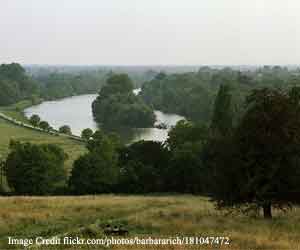
 Just 125 kilometres from Ahmedabad and twenty kilometres from Vadnagar situated the Taranga Hills on the famous Aravali mountain ranges. I personally feel that Gujarat is quite a religious state as you can find beautiful temples all around. Where ever you go it is almost impossible not to sight a shrine. You find here very attractive architecture in the form of shrines belonging to various religions. Taranga hills are also deeply connected to religions and religious shrines that too centuries old.Taranga hills come under Mehsana district of Gujarat state. It is a three peaked hill of Mehsana. Two rivers flows here one is River Rupen that flows along the hill while River Sabarmati flows in the East side of the hill. River Saraswati flows nearby the Taranga hills. Actually the path to reach Taranga hills starts from the Saraswati River banks. It seems that this place has deep connections to Buddhism as the shrine found here suggests that. This place is quite significant for Jains as there are several Jain shrines on the hill and thus it is not surprising to see various Jain monks walking on the hills barefoot. They do not wear any foot wears throughout their lives after becoming monks. This place may not be seen in most of the travel itinerary but it is actually the most precious architecture of India.At the top almost there is a little temple dedicated to Goddess Taranamata after whom the village has its name. Apart from the idol of Taranamata there is another idol of Dharanmata. These idols are said to be of Buddhist goddess Tara. The almost broken statues of lord Buddha strongly suggest presence of Buddhism in the area. These include broken statues of lord Buddha made of terracotta, four images of Buddha in meditation state carved on a stone plate. As you go ahead on the Taranga hills you find the beautiful Taranga Jain temple bathed in the fresh air of hills amidst the panoramic surroundings. This temples dates back to the twelfth century and still looks magnificent amidst the picturesque location of Taranga Hills. This historic holy shrine is said to be the best preserved but least restored monument in the entire state of Gujarat. This shrine is said to be built by Solanki dynasty and thus it is the evidence of devotion of Solanki Rajputs in religion. If you go into history you will find that the Solanki king Kumarpala who ruled from capital Patan between 1145 and 1172 turned to Jainism under the guidance of Jain scholar and poet Hemchandracharyaji. The foundation stone of this huge temple was laid by the King Kumarpala during his ruling period. He also refurbished the famous Somnath temple which was turned into ruins and constructed the walls of Vadnagar. During the ruling of Mughal Emperor Akbar who wanted diversity of religions and respected all religions, the temple was renovated at a major scale during sixteenth century. The magnificent Jain temple has a five meter heighted statue of 2nd Tirthankara of Jains named Shri Ajitnathji in a peaceful position. The entire atmosphere brings spirituality in every soul who visits the place with its calm and stillness.Taranga Hills are the most important holy place (tirtha) and considered as one of the five Mahatirthas (great holy places) of Shwetamber Jains because it is the place where people have attained enlightenment. It is called Tarangir. This place is one among 108 Siddhachals of Jains. Now let me light on the reason why this place is significant in such a magnitude because it is believed that at this place 35,000,000 saints including Vardutta and Sagardutta achieved enlightenment (moksha). That is why it is a Siddha kshetra. There are two hillocks here which are named Kotishila and Sidhshila respectively. These have idols of God Neminath and God Mallinath. Apart from these there are fourteen temples and one Dharmshala (Accommodation facility) of Digambar Jains is situated at the bottom of the hills. From the time of Ajitnath Bhagwan who is the second tirthankar of Jains Digambar Jains are settled here.Distance from Taranga hillsAhmedabad – 125 kilometresMehsana — 56 kilometresAmbaji shrine – 50 kilometresRUCHI MAHAJAN